
7 Ways to Increase Appointment Fill Rate in Your Aesthetic Clinic
In an aesthetic clinic, revenue depends directly on how full the calendar is. A doctor works by the hour; when that hour goes empty, the loss can never be recovered. Rent, staff salaries and fixed costs keep running during an empty hour too. That is why appointment fill rate is one of the most direct profit indicators in aesthetic clinic management.
20 July 20269 min read
In this article
- What Is Appointment Fill Rate and Why Does It Matter?
- 1. Don’t Miss Demand That Arrives After Hours
- 2. Turn Incoming Demand Into Appointments Quickly
- 3. Don’t Leave Freed-Up Hours Unclaimed
- 4. Move One-Time Patients Into the Session Cycle
- 5. Turn Consultation Appointments Into Treatments
- 6. See the Gaps in Your Calendar in Advance
- 7. Act Where the Data Points
- Which Aesthetic Clinics Benefit Most From These Methods?
- Frequently asked questions
In most clinics, increasing fill rate is understood as “running more ads.” Yet a significant share of the demand is already arriving; the problem is that this demand gets missed, that the gaps in the calendar go unseen, and that the patient who does come stays a one-time visitor. Closing these leaks before raising your ad budget often gives much faster results.
In this guide we walk step by step through seven concrete ways to raise your aesthetic clinic’s appointment fill rate, and how each one can be put into practice with Flextell.
What Is Appointment Fill Rate and Why Does It Matter?
Appointment fill rate is the ratio of the appointment hours filled in a given period to the total available appointment capacity. If a doctor has eight appointment hours a day and six of them are filled, that day’s fill rate is 75 percent.
This metric is not just a number; it is a summary of the clinic’s operational health. A low fill rate points to one of three things: not enough demand is coming in, the demand that comes in is not turning into appointments, or booked appointments are going to waste because of no-shows. Each cause calls for a different intervention, so to raise fill rate you first need to see which link is weak.
In aesthetic clinics this metric carries special weight. A heavy but scattered stream of demand from social media, a repeating session structure and communication traffic that spills outside business hours all turn fill rate into both an opportunity and a risk area.
Want to explore every dimension of aesthetic clinic management? You can find our guide to digital transformation in aesthetic clinic management here.
1. Don’t Miss Demand That Arrives After Hours
A significant part of an aesthetic clinic’s patient traffic happens outside business hours. A potential patient who sees a results photo on Instagram in the evening, or who researches a treatment on the weekend, sends a message right then. If the clinic is closed and the message goes unanswered until morning, most of that demand moves to another clinic.
This is the quietest leak in fill rate: the demand actually arrived, but because it was not caught, it is treated as if it never existed.
Flextell’s AI assistant receives messages arriving through WhatsApp, Instagram DM and Telegram at every hour of the day. It offers the right doctor for the treatment and the available times, gets confirmation and saves the appointment to the calendar. A message like “Can I book a filler appointment for tomorrow?” that arrives at 23:00 does not go unanswered; by the time staff arrive in the morning, the calendar is already filled with that appointment.
Curious how a 24/7 automatic patient reply system works? You can find our detailed guide here.
2. Turn Incoming Demand Into Appointments Quickly
Catching the demand is not enough; it has to turn into an appointment. If a patient asks “What’s your price?” and the reply comes hours later, their motivation has long since faded. In aesthetic clinics the decision moment is short: the patient sees a piece of content, writes on the impulse, and if they get a fast reply, they come back to book.
Delayed replies are the second big leak, where incoming demand melts away before becoming an appointment.
Flextell’s assistant understands the intent of the incoming message and replies instantly, drawing on clinic data. It answers a price question with the information defined in the system and an appointment request with real availability. The patient is not put on hold; the conversation moves toward an appointment the moment the request arrives. Because it can talk with several patients at once, reply speed does not drop even at busy hours.
Because this system works not with ready-made templates but with the real data the clinic has entered into the system, conversion stays high.
You can read the details of turning Instagram DM requests into appointments here.
3. Don’t Leave Freed-Up Hours Unclaimed
Not every confirmed appointment is guaranteed. Patients cancel, postpone or never show up. If that freed hour is not immediately opened to a new appointment, it becomes a slice that looks full on the calendar but actually goes empty. This is one of the things that lowers fill rate the most: the hour is technically full but produces no revenue.
In Flextell, when a patient cancels or changes an appointment, the AI assistant processes the request and automatically makes that hour available on the calendar. Staff do not need to notice the message or update the calendar by hand. Because the freed slice is instantly opened to new appointments, it can be filled with another patient on the same day.
The patient who cancels is not a permanent loss either; an automatic win-back message sent after a certain period invites that patient to book again. So a single cancellation is made up for in two ways: by putting the freed hour back to use and by winning the patient back.
Want to explore all the mechanisms of no-show and cancellation management? You can find our guide to patient appointment reminder systems here.
4. Move One-Time Patients Into the Session Cycle
In aesthetic clinics, the highest fill potential comes not from new patients but from existing patients coming back. Laser hair removal requires six to eight sessions, fillers are renewed at set intervals, and skin care protocols are kept up regularly. Every completed session is a chance to add the next one to the calendar; when that chance is missed, the patient forgets their next session and the appointment that was supposed to appear on the calendar never does.
Flextell’s session plan module runs this cycle automatically. Each treatment is given a number of sessions and a session interval. When a session is completed, the system calculates the date range of the next session, finds an available slot and sends the patient an automatic session confirmation message. When the patient confirms, the appointment is added to the calendar.
The effect on fill rate is direct: a one-time laser appointment turns into a self-continuing chain of eight session appointments. Because the patient card always shows how many sessions have been completed and how many remain, a patient who starts skipping sessions is also noticed early.
Curious how multi-session treatment tracking works? You can find our guide to clinic treatment and session plan management here.
5. Turn Consultation Appointments Into Treatments
Most aesthetic clinics first welcome a new patient with a short consultation session. But a consultation creates value not just when it takes place, but when it turns into a treatment. Every patient who comes for a consultation and does not return for treatment has taken up an hour on the calendar without turning that fill into sustainable revenue.
Flextell’s AI assistant can be set up so that first-time patients are offered a consultation session first, instead of booking a treatment appointment directly. This flow is defined according to the clinic’s own protocol. More importantly, the system makes consultation-to-treatment conversion trackable: how many consultations were held, and how many turned into treatments.
This visibility is a lever for raising fill rate. When conversion is seen to be low, setting up a post-consultation follow-up message becomes a concrete step that steers the undecided patient toward treatment. The hours set aside for consultations become the first step of a measurable pipeline.
6. See the Gaps in Your Calendar in Advance
An often overlooked way to raise fill rate is to see empty hours ahead of time and actively fill them. A clinic that is packed on Monday evenings but does not notice that Thursday afternoons are chronically empty loses part of its capacity every week.
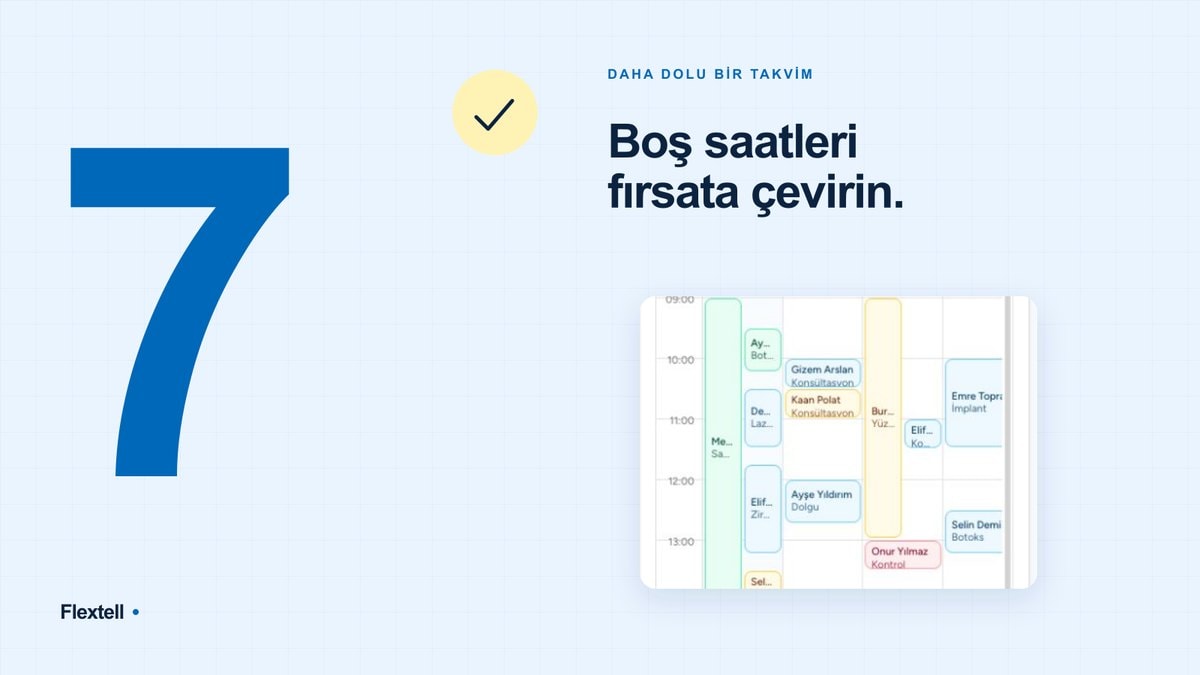
Flextell’s calendar views make these gaps visible. The daily view shows that day’s flow in hourly order; the weekly view presents busy and sparse days together; and the monthly view lets you read seasonal peaks in advance, such as the laser season before summer or New Year package periods. In clinics with multiple doctors, all the doctors’ calendars are shown side by side; which doctor is free at which hour can be read at a glance.
This visibility can be turned into action. Once chronically empty slices are identified, it becomes possible to run targeted campaigns for those hours or to prioritize those slices when scheduling sessions. An empty hour stops being an unavoidable reality and becomes a manageable variable.
Curious about all the features of clinic calendar management? You can find our detailed guide here.
7. Act Where the Data Points
The most common mistake when trying to raise fill rate is intervening without knowing where the problem is. Is demand insufficient, is conversion low, are no-shows high? The answers to these questions should come from data, not guesswork; otherwise energy is spent in the wrong place.
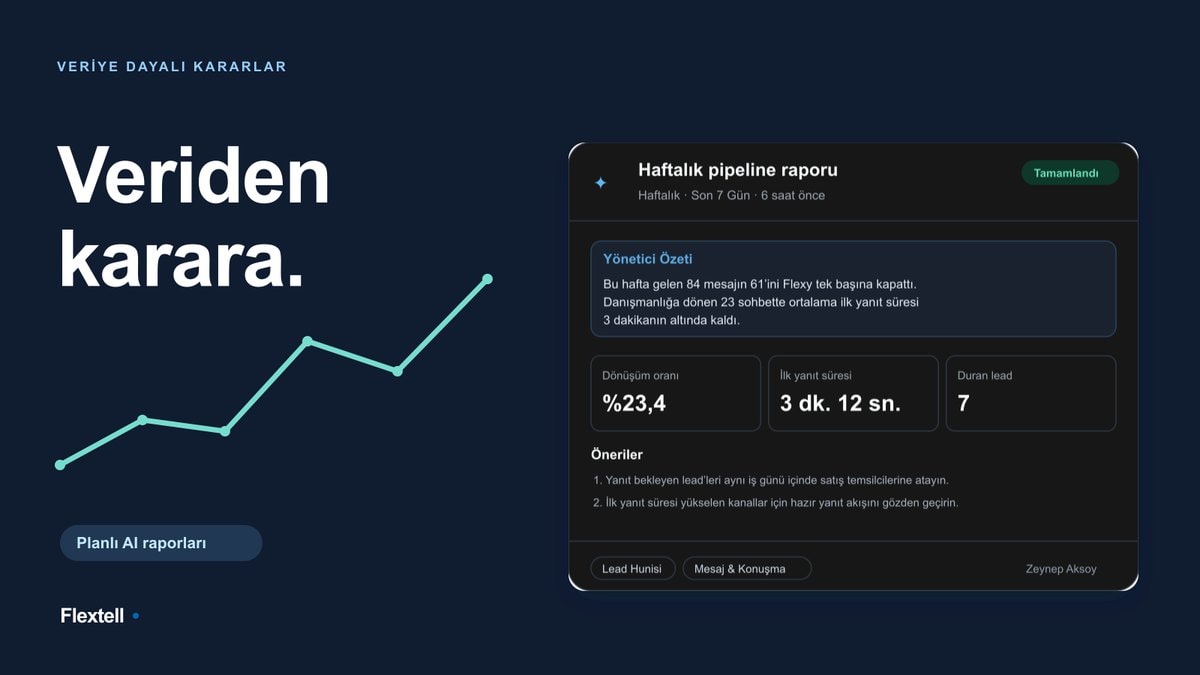
Flextell’s AI-powered reporting module automatically compiles metrics such as appointment fill rate, no-show distribution, revenue by treatment and staff productivity from 10 different system sources and turns them into a report with commentary. This report does not just summarize the past; it also offers insights, such as the time slots where fill rate drops and the treatments with high no-show rates, along with actionable recommendations.
This analysis is the link that makes the previous six ways accurate. When you can see with data which hours have gaps, which treatments need reminder timing moved earlier, and where consultation conversion gets stuck, your effort to raise fill rate rests on concrete data, not guesses. Reports can be generated automatically on a daily, weekly or monthly schedule and exported as PDF.
Which Aesthetic Clinics Benefit Most From These Methods?
These seven ways create value for every aesthetic clinic, but some profiles get a larger share from fill rate optimization.
Botox and filler clinics: Instant demand from social media is heavy. Catching after-hours demand and converting quickly translates directly into higher fill rate in these clinics.
Multi-doctor aesthetic polyclinics: Managing several calendars side by side, spotting empty slots and balancing capacity between doctors make a critical difference in these setups.
Small clinics with a single doctor and an assistant: Because staff capacity is limited, all after-hours demand cannot be handled by hand. The AI assistant closes this gap without hiring extra staff.
Laser hair removal and skin care centers: The session package structure is the strongest source of sustained fill. The automatic session confirmation flow turns the calendar into a loop that feeds itself.
Frequently asked questions
Do I need to raise my ad budget to increase appointment fill rate?
In most cases, no. A significant share of fill rate losses comes from missed incoming demand, freed-up hours that are not refilled, and existing patients who stay one-time visitors. When these leaks are closed, fill rate rises even without raising the ad budget. Advertising becomes a meaningful next step only after existing demand is managed efficiently.
Does a freed-up appointment hour get refilled automatically in Flextell?
The hour automatically becomes available at the moment of cancellation and is opened to new appointments. A win-back message can be sent to the patient who cancelled to fill that hour; in addition, that slice immediately appears available for new incoming requests. The system does not leave the hour empty, but it creates the new appointment based on the patient’s request.
How do I track my fill rate in Flextell?
Flextell’s reporting module automatically calculates appointment fill rate, no-show distribution and performance by treatment. This data appears in daily, weekly or monthly reports; the analyses show at which hours and treatments fill rate drops.
Do session packages really affect fill rate?
Yes, they are one of the strongest levers. A single laser hair removal package, when tracked automatically by the system, turns into a chain of six to eight appointments. Because each completed session adds the next one to the calendar, the package structure feeds the calendar regularly.
Does the AI assistant create conflicts in appointments it books after hours?
No. The system technically does not allow a second appointment to be entered into an occupied hour. This check works the same way for appointments coming through the assistant and for manual entries made from the panel; blocks on the doctor’s Google Calendar or Outlook calendar are also taken into account.
Do I need to apply all seven methods at the same time?
No. Each method creates value on its own, but their effects multiply when applied together. Catching after-hours demand, converting it quickly, filling freed-up hours and moving existing patients into the session cycle are different links of the same fill goal.
Fill Rate Is the Result of a System, Not a Single Action
Raising appointment fill rate in your aesthetic clinic is possible not through a single magic intervention but through all the links of a chain working together, from catching demand to converting it, from refilling an empty hour to winning back an existing patient. When one link stays weak, the fill the others gain leaks out through it.
Flextell runs these seven ways on a single platform as connected modules. 24/7 demand capture, fast conversion, automatic empty-slot management, the session package cycle, consultation conversion tracking, calendar visibility and AI-powered reporting are all parts of the same system. As the clinic grows, this wholeness becomes even more decisive, because every gap that has to be handled by hand means an hour of lost revenue.
If you want to see how your clinic’s calendar fills up, you can request a demo or start a free trial right away.
This content was prepared by the Flextell team. Last updated: July 2026.