
Clinic Appointment Management Over WhatsApp
In Turkey, when patients want to reach a clinic, they most likely prefer not to phone. They write on WhatsApp instead. This preference holds regardless of age group and clinic type; WhatsApp has become the de facto standard of patient communication.
24 April 20269 min read
In this article
- Why Has WhatsApp Moved to the Center of Clinic Communication?
- The WhatsApp Appointment Flow in Flextell: Step by Step
- Conflict Prevention: Applies to Appointments From WhatsApp Too
- After-Hours WhatsApp Traffic: Starting the Morning With an Appointment List, Not a Pile of Messages
- Automatic Reminders for Appointments From WhatsApp
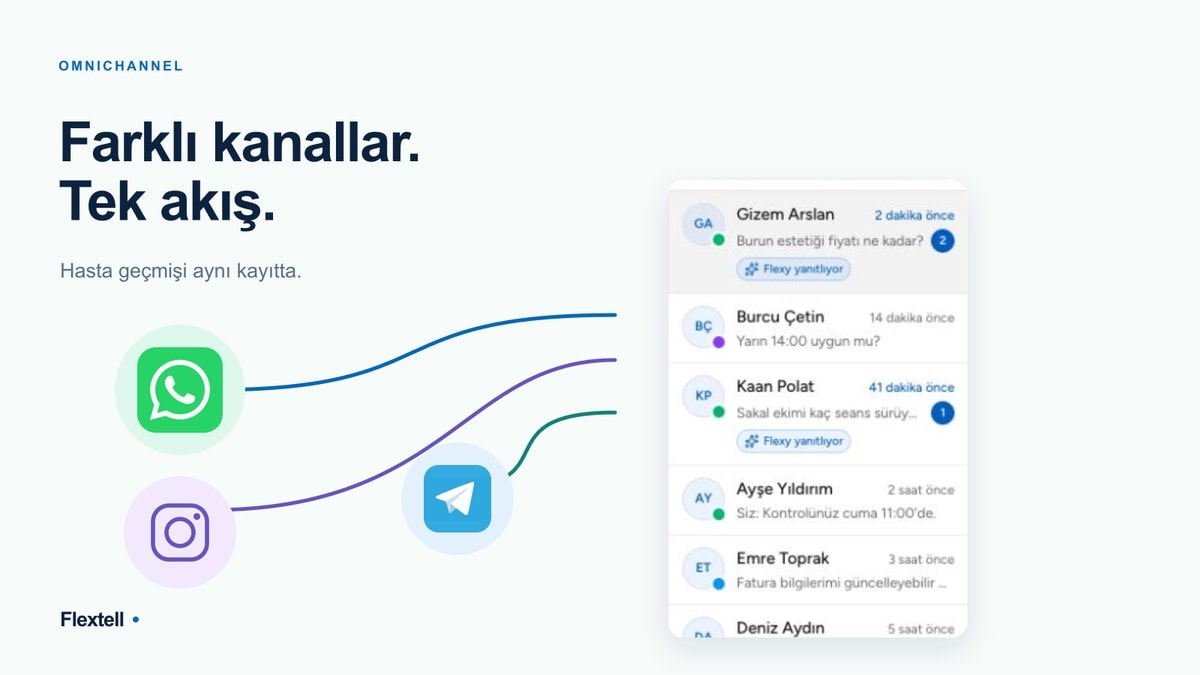
- WhatsApp, Instagram DM and Telegram: Management From a Single Panel
- Patient Information From a WhatsApp Conversation Is Added to the Patient Card Automatically
- Which Clinics Benefit Most From This System?
- Frequently asked questions
- WhatsApp Is No Longer Just a Messaging App
What this picture means in practice for a clinic is this: a significant share of the appointment requests, cancellation messages and patients who want to ask a question during the day flow through WhatsApp. Managing this flow manually (reading every message, answering, entering it on the calendar, sending reminders) creates a high-frequency, repetitive workload for staff. As the clinic grows, this load gets disproportionately heavier.
Flextell’s AI assistant manages patient traffic coming through WhatsApp from start to finish: it receives the message, understands the intent, produces a reply from clinic data, enters the appointment on the calendar and sends the reminder on time. All of this runs 24/7 without interruption, with no need for staff to keep WhatsApp open separately.
In this article we walk step by step through how Flextell’s WhatsApp appointment management works.
Why Has WhatsApp Moved to the Center of Clinic Communication?
WhatsApp’s weight in clinic communication is no coincidence. A phone call requires synchronous communication for both patient and clinic: both sides have to be available at the same time. If staff are busy when the patient calls the clinic, the call does not happen; the appointment is postponed or the patient tries another clinic.
WhatsApp removes this synchronization problem. The patient writes at any hour they like; the clinic replies when it is available. The message record stays, misunderstandings decrease, and appointment details are communicated in writing. This structure works more easily in practice for both the patient and the clinic.
But this convenience brings a management problem. WhatsApp messages demand attention the moment they arrive; unanswered messages pile up and turn into a heap that staff follow as their turn comes. While one patient waits for a reply, another patient’s cancellation message goes unread; the freed hour cannot be put to use.
To solve this management problem, Flextell connects the WhatsApp channel to the AI assistant.
The WhatsApp Appointment Flow in Flextell: Step by Step
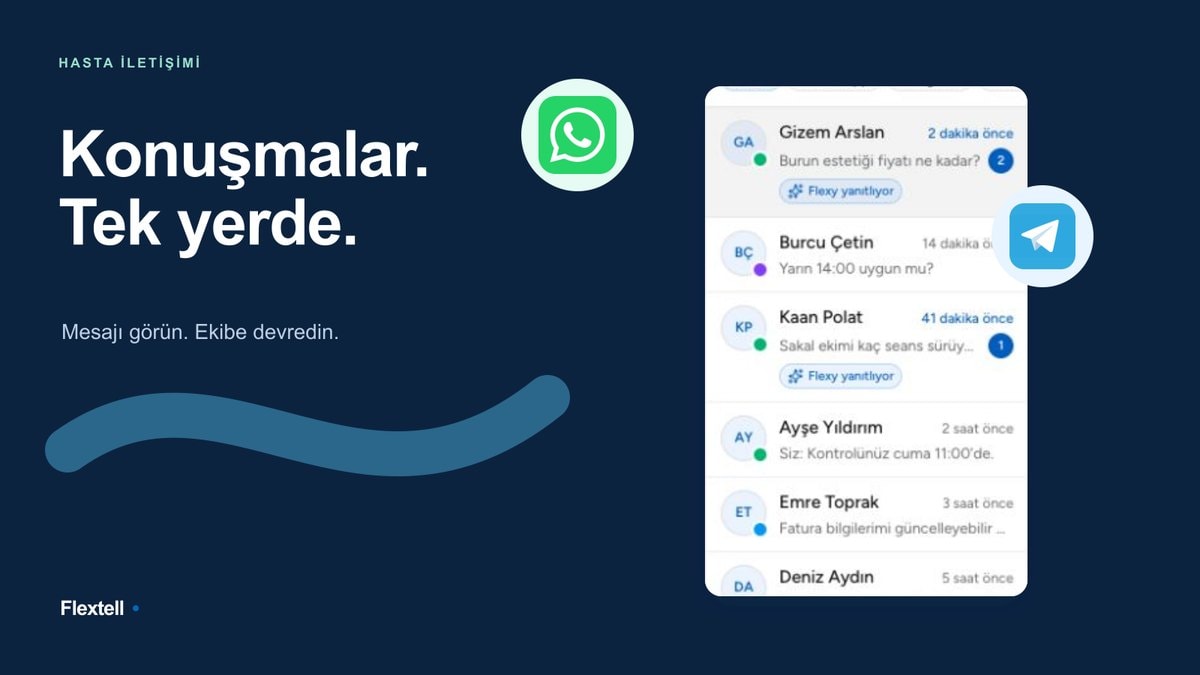
Once Flextell’s WhatsApp integration is set up, messages from this channel land directly in the Flextell panel. Staff do not need to keep the WhatsApp app open separately or follow messages there. The message is written there, and it is visible and processed in Flextell.
The AI assistant receives these messages in real time. The flow goes like this:
Step 1 — The message is received. The patient sends the clinic a message on WhatsApp. Regardless of hour, content or subject, the system detects it instantly.
Step 2 — The intent is understood. The AI assistant determines what the message asks for: do they want an appointment, are they asking about a price, do they want to cancel, are they looking for an address? Each message is evaluated in its own context; no generic template is applied.
Step 3 — Clinic data is checked. The information matching the request is pulled from the system. For an appointment request, the calendar is checked in real time: the doctors assigned to the relevant treatment, available times for that day or week, and working-hours limits. While running these checks, the assistant draws on the real data defined in Flextell; it does not produce a generic or default reply.
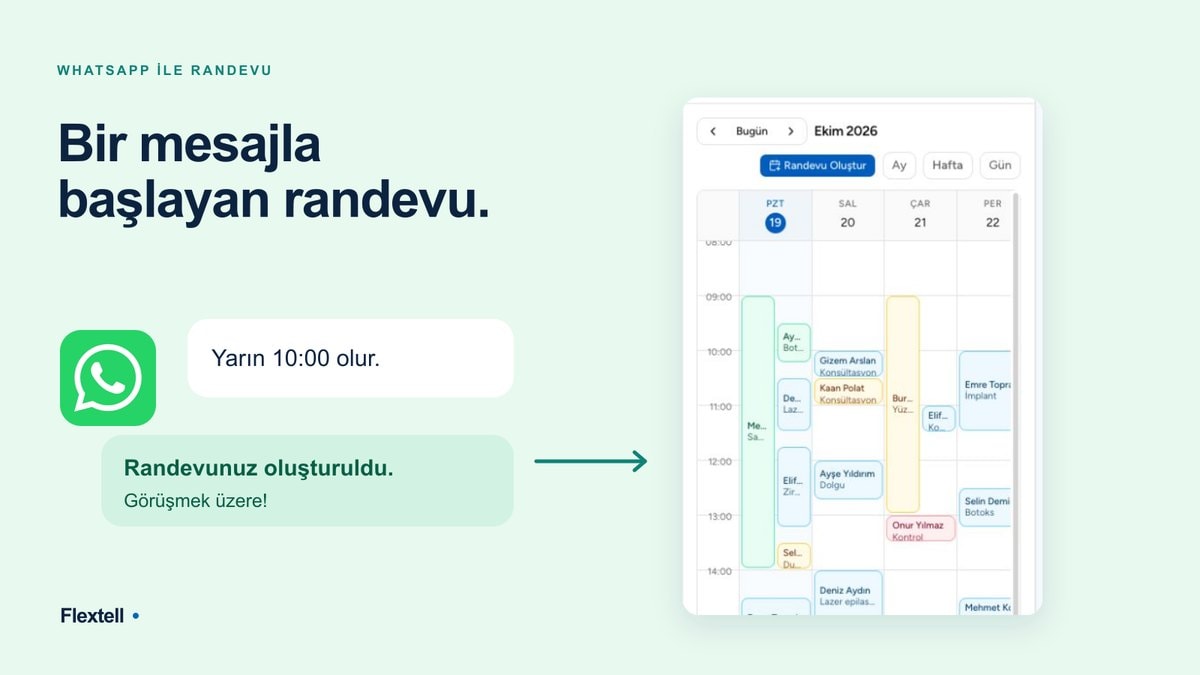
Step 4 — The reply is delivered. The AI assistant replies to the patient. For an appointment request, available options are offered, the patient makes a choice, confirmation is received and the appointment is saved to the Flextell calendar automatically.
Step 5 — Handover to staff when needed. In cases the assistant cannot answer or that require human involvement, the system automatically opens a support request and sends a notification to the relevant staff. When staff are available, they take over the conversation.
These five steps run from scratch in every conversation. A message at 02:00 and a message at 14:00 go through the same flow; reply quality does not change.
Conflict Prevention: Applies to Appointments From WhatsApp Too
Appointments taken over WhatsApp are subject to exactly the same rules in Flextell as other appointments. Entering a second appointment for the same doctor at the same hour is technically not possible. This check works equally for appointments entered manually from the panel and for WhatsApp requests that come through the AI assistant.
Likewise, the system does not allow an appointment to be booked outside working hours. Even if a patient writes on WhatsApp at 23:00, “Can I book an appointment for 7 tomorrow morning?”, the assistant sees that this time falls outside working hours and does not show it among the available times.
If there is an hour blocked on the doctor’s Google Calendar or Outlook calendar, that block is reflected in Flextell too; that hour is closed to appointment requests from WhatsApp as well.
This mechanism is not a manual check or a rule left to staff control; it is a block enforced technically by the system.
Want to learn more about calendar conflict prevention and Google Calendar/Outlook sync? You can find our guide to clinic calendar management here.
After-Hours WhatsApp Traffic: Starting the Morning With an Appointment List, Not a Pile of Messages
A significant share of patient messages arrives in the evenings and on weekends. At those hours the clinic is closed; there is no staff. Messages go unanswered until morning.
This picture has two costs for a clinic. First, a time-sensitive appointment request may not be able to wait for morning: the patient turns to another clinic in the meantime. Second, staff start the day with a pile of accumulated messages when they arrive in the morning; reading every message, checking the calendar and writing replies can take hours.
Flextell’s AI assistant solves both problems at once. WhatsApp messages that arrive in the evening do not go unanswered; the assistant processes appointment requests, answers questions and receives cancellation notices. When staff arrive in the morning, in place of the pile of messages they find a list of appointments already entered on the calendar.
Automatic Reminders for Appointments From WhatsApp
The moment an appointment is confirmed, Flextell’s reminder flow starts. Since it is known that the patient communicates over WhatsApp, the reminder message is also sent through the same channel; the patient does not have to open another app or check their email.
When the reminder is sent can be set according to the clinic’s preference. A commonly used setup is a first reminder 3 days before the appointment and a final reminder 24 hours before. In both messages, the appointment date, time and doctor’s name are filled in automatically; the clinic does not send a generic template, the patient receives their own real information.
Treatment-specific preparation information can also be added to the reminder message. For a procedure that requires fasting before the appointment, that instruction; for a session where waxing should be avoided, that note; goes into the message automatically. The patient is both reminded and comes prepared.
If the patient replies to the reminder with a cancellation or change request, the AI assistant processes the request. The freed hour automatically becomes available on the calendar. Staff do not need to separately see, read the message or update the calendar; this loop runs by itself in the background.
Curious how a reminder system is set up to lower the no-show rate? You can find our detailed guide to patient appointment reminder systems here.
WhatsApp, Instagram DM and Telegram: Management From a Single Panel
Clinics rarely work with the WhatsApp channel alone. While one patient writes on WhatsApp, another may be reaching you on Instagram DM and another on Telegram. Following these three channels in separate apps takes time and sets the stage for missed messages.
In Flextell, all messages arriving through WhatsApp, Instagram DM and Telegram are collected on a single panel. Messages listed in the inbox view are managed on the same screen, regardless of channel. The AI assistant works on all three channels at the same time; each of the conversations held with several patients at once moves forward in its own context.
The practical meaning of this integrated structure for the clinic is this: there is no pile of messages on WhatsApp because the assistant works there too. There are no unanswered appointment requests on Instagram because the single panel covers every channel. When staff arrive in the morning, all communication is in front of them in an organized form, regardless of which channel it came from.
Curious how all communication channels are managed in a single panel? You can find our guide to the 24/7 automatic patient reply system here.
Patient Information From a WhatsApp Conversation Is Added to the Patient Card Automatically
In the first conversation over WhatsApp, the patient shares their name and request. In Flextell, this information is automatically recorded on the patient card; staff do not need to enter information from the conversation into the system separately.
If the patient has written to the clinic on WhatsApp before and has a record in the system, the AI assistant recognizes that record in the new conversation. When creating an appointment, you can reach that patient’s past appointments, treatment notes and contact details from the same screen. The patient does not have to be introduced from scratch every time; the system carries the earlier context.
This feature’s contribution to the clinic is cumulative. With hundreds of active patients, instead of re-identifying each one every time, the process continues with information compiled automatically from the WhatsApp conversation.
Want to discover all the modules of the patient card? You can find our detailed guide to patient tracking software here.
Which Clinics Benefit Most From This System?
Flextell’s WhatsApp appointment management creates value for clinics of every size, but in some profiles that value shows up more clearly.
Aesthetic and beauty clinics: In these clinics, which see heavy appointment traffic over WhatsApp and Instagram DM, the assistant handles requests arriving from both channels at once; the process works the same way whichever channel the message is written on.
Clinics with a single doctor and an assistant: In setups with few staff, WhatsApp traffic can become completely unmanageable after hours. The AI assistant closes this gap without extra staff; the assistant who arrives in the morning starts the day not with the night’s WhatsApp messages but with a list of processed appointments.
Laser hair removal and session-based treatment centers: In repeat session appointments, the cycle of sending a new appointment confirmation message after each session and the patient needing to reply creates heavy WhatsApp traffic. This traffic is carried by the AI assistant without staff involvement.
Multi-doctor polyclinics: In setups where several doctors work, routing appointment requests from WhatsApp to the right doctor and preventing calendar conflicts are processes that are hard to track by hand. The system routes automatically using the doctor-treatment match; the conflict prevention mechanism works equally for all doctors.
Frequently asked questions
Does setting up the WhatsApp integration require technical knowledge?
No. Setting up the integration consists of steps that do not require technical infrastructure. Once the channel is connected, incoming messages start landing in the Flextell panel automatically. The Flextell team provides support during setup.
Can the AI assistant answer every kind of question on WhatsApp?
The assistant produces replies drawing on the clinic data defined in Flextell: doctor profiles, treatment descriptions, price information and working hours. The more comprehensive the information entered in the system, the wider the range of questions the assistant can answer. When it cannot answer, the system automatically opens a support request and sends a notification to staff.
Does the calendar conflict check work for appointments from WhatsApp too?
Yes. The conflict prevention mechanism applies equally to appointments taken over WhatsApp and to manual entries made from the panel. The system technically does not allow a second appointment to be entered into an occupied hour.
After a patient writes on WhatsApp and books an appointment, can they also write on another channel?
Yes. Messages from different channels are collected in the same Flextell panel. Information linked to the patient card applies to all channels; even if the patient booked an appointment on WhatsApp, they can continue their next conversation on Instagram DM.
How many patients can the AI assistant communicate with over WhatsApp at the same time?
There is no technical limit on simultaneous communication. In busy periods the assistant holds conversations with several patients at once; reply time may vary depending on the number of patients writing at the same time.
Are reminder messages sent over WhatsApp?
If the patient communicated over WhatsApp, the reminder is sent through the same channel. The patient does not have to open another app or check their email; the message appears on the channel they are already actively using.
What happens if a wrong message is sent on WhatsApp?
The AI assistant produces replies from the clinic data defined in Flextell. If the information entered into the system is correct, the reply is correct; if data is missing, the reply is incomplete too. That is why it is important to keep doctor profiles, treatment definitions and working hours current. When the assistant is not sure, the system automatically opens a support request and sends a notification to staff.
WhatsApp Is No Longer Just a Messaging App
For clinics, WhatsApp has long since gone beyond a communication preference; it is the primary channel through which patients expect to reach the clinic. Managing this channel manually (reading every message, answering, updating the calendar, sending reminders) becomes unsustainable as the clinic grows.
In Flextell, WhatsApp works within an integrated structure of booking, reminders, cancellation management and patient card integration. Staff do not have to keep watching WhatsApp; the system manages it in the background. Only the moments that truly need a human touch reach staff’s agenda.
If you want to see how the AI assistant works across the clinic, you can look at our guide to the clinic AI assistant here.
This content was prepared by the Flextell team. Last updated: April 2026.